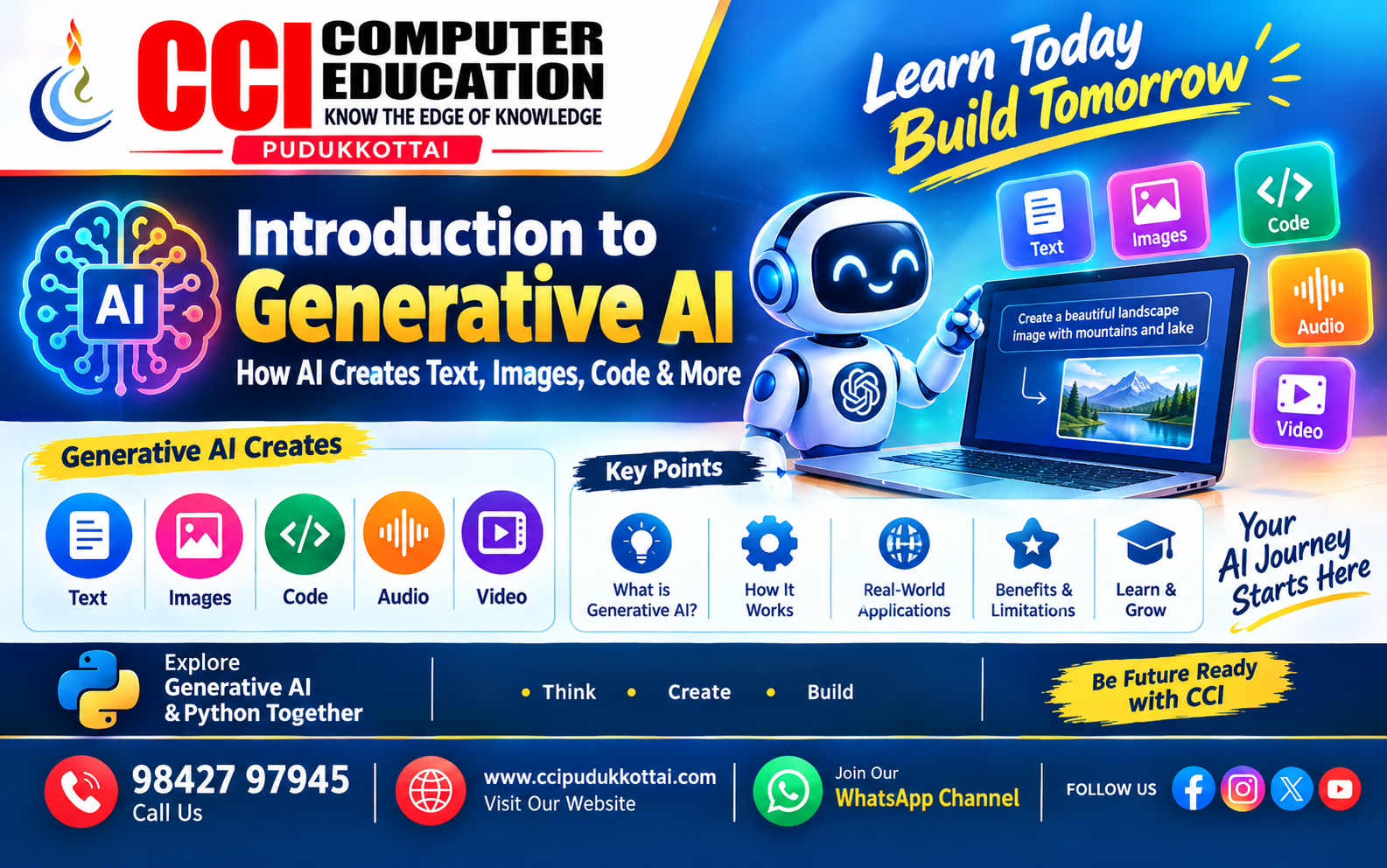
Introduction to Generative AI – How AI Creates Text, Images, Code and More
Published: 06 Oct, 2026 | Author: CCI Admin | Category: AI / Artificial Intelligence
Generative AI is one of the most exciting areas of Artificial Intelligence. It can create new content such as text, images, code, audio, and videos based on instructions provided by a user.
In this blog, we will learn the basics of Generative AI, how it works, where it is used, and how students can start using it effectively.
What is Generative AI?
Generative AI is a type of Artificial Intelligence that can create new content based on patterns learned from large amounts of data.
Traditional AI is often used to analyze data, make predictions, or classify information. Generative AI goes a step further by producing new content based on a user's instructions or prompts.
What Can Generative AI Create?
Generative AI can create different types of digital content.
- Text: Articles, summaries, explanations, and stories.
- Code: Programs, functions, and code suggestions.
- Images: Posters, illustrations, and creative designs.
- Audio: Speech, music, and sound content.
- Video: AI-generated video and visual content.
How Does Generative AI Work?
Generative AI models are trained using large amounts of data. During training, the model learns patterns and relationships from that data.
When a user provides a prompt, the AI processes the instruction and generates an output based on what it has learned.
User Prompt
     ↓
Generative AI Model
     ↓
Process Patterns
     ↓
Generate Output
     ↓
Text / Image / Code / Audio
What is a Prompt?
A prompt is an instruction, question, or description given to an AI system to produce a desired response.
A clear prompt can help the AI understand what the user needs.
Prompt:

"Explain Python functions with a simple example
for a beginner."
The AI can generate an explanation and a suitable Python example based on this instruction.
Simple Generative AI Example
Suppose a student wants to understand Python loops. Instead of simply searching for information, the student can provide a specific prompt.
Prompt:

"Explain Python for loop in simple English
and give three beginner-friendly examples."
Generative AI can then provide an explanation and examples that the student can study and practice.
Generative AI vs Traditional AI
| Feature | Traditional AI | Generative AI |
|---|---|---|
| Main Purpose | Analyze or predict | Create new content |
| Output | Prediction or classification | Text, images, code, audio, etc. |
| Example | Spam detection | AI-generated article |
Popular Applications of Generative AI
Generative AI is being used in many areas of technology and business.
- Education: Creating explanations, notes, quizzes, and study materials.
- Programming: Generating code and helping developers debug programs.
- Marketing: Creating advertisements, content ideas, and social media posts.
- Design: Creating images, posters, and design concepts.
- Business: Creating reports, documents, and customer-support content.
- Entertainment: Creating stories, music, images, and videos.
Benefits of Generative AI
- Helps save time.
- Generates ideas quickly.
- Supports programming and learning.
- Helps automate repetitive tasks.
- Supports creativity.
- Can provide personalized explanations.
Limitations of Generative AI
Generative AI is powerful, but it should be used carefully. AI-generated information may sometimes contain mistakes or incorrect information.
- AI-generated information should be verified.
- AI can sometimes produce incorrect answers.
- Sensitive personal information should not be shared unnecessarily.
- AI-generated code should be tested before use.
- Human knowledge and judgment are still important.
How Students Can Use Generative AI
Students can use Generative AI as a learning assistant to understand difficult concepts and practice new skills.
Students can ask AI to:

1. Explain a programming concept.
2. Give simple coding examples.
3. Find errors in a program.
4. Create practice questions.
5. Explain difficult topics.
6. Suggest project ideas.
Real-World Example – Learning Python
Imagine a student is learning Python dictionaries but does not understand key-value pairs.
Prompt:

"Explain Python dictionaries to a beginner
using a student information example."
Generative AI can provide a simple explanation and example that the student can then practice using Python.
Generative AI in Software Development
Generative AI can also assist programmers during software development. Developers can use AI to understand code, generate examples, find possible errors, and improve existing programs.
Example Prompt:

"Write a simple Python program to calculate
the average of three numbers."
The generated program should still be reviewed, understood, and tested by the developer.
Important Generative AI Skills for Students
| Skill | Purpose |
|---|---|
| Prompt Writing | Give clear instructions to AI |
| AI Tools | Understand and use AI applications |
| Critical Thinking | Check whether AI output is correct |
| Programming | Understand and test AI-generated code |
| Responsible AI Usage | Use AI safely and ethically |
Common Mistakes When Using Generative AI
- Copying AI-generated answers without understanding them.
- Using unclear or incomplete prompts.
- Trusting every AI answer without verification.
- Using AI-generated code without testing it.
- Sharing sensitive information with AI tools.
Faculty Tip
For students: Use Generative AI as a learning assistant, not as a replacement for your own thinking. Ask AI to explain concepts, provide examples, and give practice problems. Then solve and test the problems yourself.
Practice Task
Try the following prompt using a Generative AI tool:
"Explain Python functions to a beginner.
Give one simple real-world example and
three practice questions."
Read the generated answer, write the example yourself, and solve the practice questions without simply copying the AI response.
Frequently Asked Questions
1. What is Generative AI?
Generative AI is a type of Artificial Intelligence that can create new content such as text, images, code, audio, and video.
2. What is a prompt?
A prompt is an instruction or question given to an AI system to generate a specific response.
3. Can Generative AI create programming code?
Yes. Generative AI can generate programming code, explain code, and help identify possible programming errors. The code should always be reviewed and tested.
4. Can students learn Generative AI?
Yes. Students can begin with basic AI concepts, prompt writing, responsible AI usage, and practical AI tools.
5. Is every Generative AI answer correct?
No. AI-generated information should be checked and verified before depending on it, especially for important decisions.
Conclusion
Generative AI is an important technology that is changing the way people create content, learn, develop software, and solve problems.
By understanding prompts, AI tools, responsible usage, and basic AI concepts, students can develop valuable skills for the modern technology industry.
Generative AI is not only a tool for creating content. It can also become a powerful learning assistant when used with proper understanding and critical thinking.
What to Learn Next?
- What is Artificial Intelligence?
- Machine Learning Explained
- How ChatGPT Works
- AI Prompt Engineering
- Generative AI Tools for Students
Related CCI Blogs
- The Future of AI and Machine Learning
- How a Loan Approval Prediction System Works – A Real-Life Machine Learning Project
- Python Conditional Statements – if, elif and else
Learn More About Artificial Intelligence
Interested in learning Artificial Intelligence, Python, Machine Learning, and modern IT skills? Get More Information About Our Courses at CCI Computer Education – Pudukkottai.
Contact CCI Computer Education – Pudukkottai
Want to learn AI, Python, Programming, Web Development, and other computer technologies?
Call: 98427 97945 | Website: ccipudukkottai.com | WhatsApp Channel: Join Now