What Is Natural Language Processing (NLP)? A Beginner’s Guide with Examples
Published: 24 Oct, 2026 | Author: CCI Admin | Category: AI / Artificial Intelligence / NLP
Have you ever asked a question to ChatGPT, used Google Translate, or spoken to a voice assistant? These technologies use Artificial Intelligence to process human language. One of the important technologies behind these applications is Natural Language Processing, commonly known as NLP.
In this beginner-friendly guide, you will learn what NLP is, how it works, its major tasks, real-world applications, and simple Python examples.
What Is Natural Language Processing (NLP)?
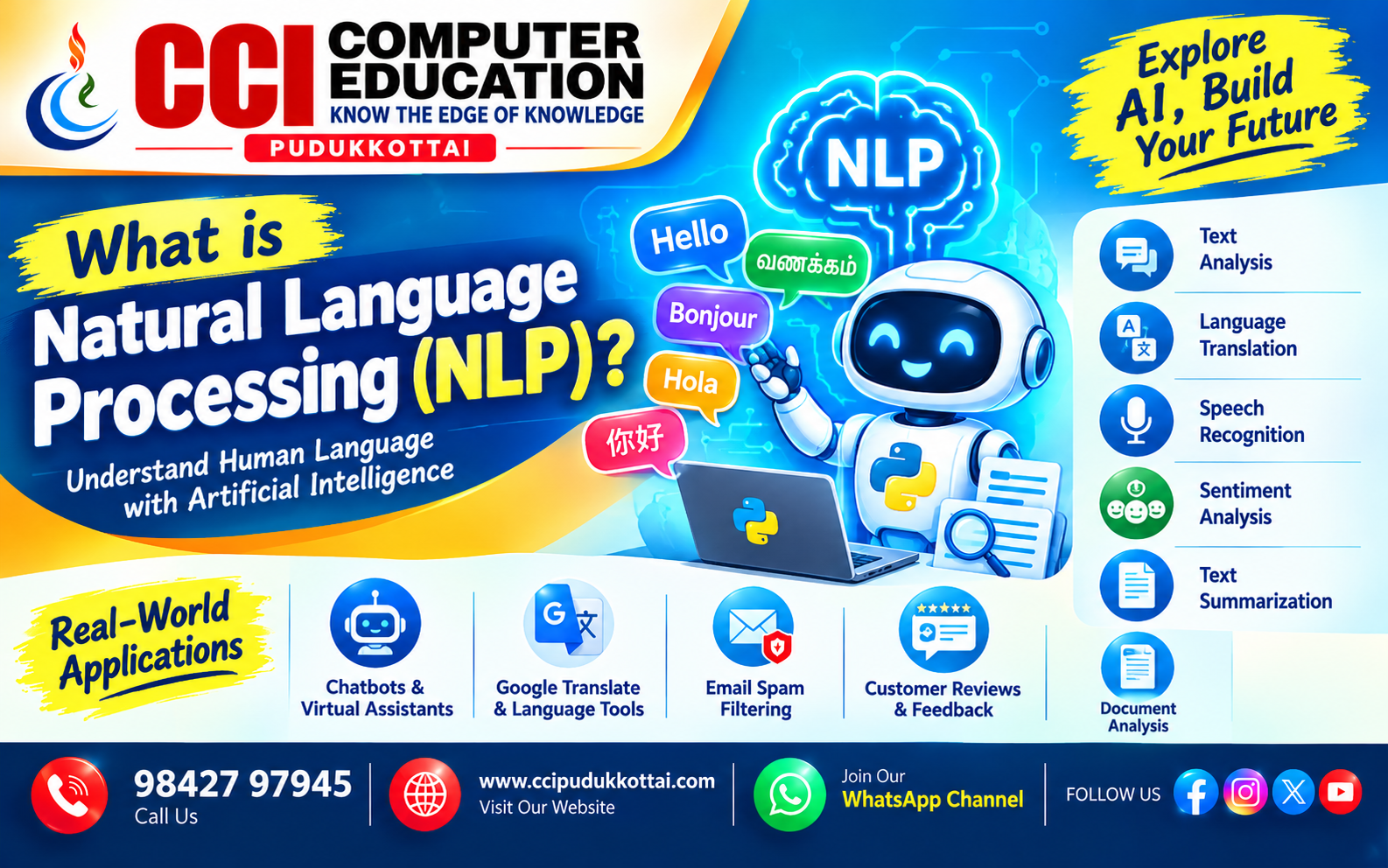
Natural Language Processing (NLP) is a branch of Artificial Intelligence that enables computers to process, analyze, interpret, and generate human language, such as English and Tamil.
NLP combines techniques from computer science, linguistics, and machine learning to help computers work with text and speech.
Simple example:
When you type "I love this course" into a sentiment analysis application, an NLP system can analyze the sentence and classify it as positive.
How Does NLP Work?
NLP systems use different steps to process language. The exact process depends on the application and the model being used.
- Input: The system receives text or speech.
- Preprocessing: The text may be cleaned, divided into smaller units, or normalized.
- Language analysis: The system identifies patterns, words, context, or meaning.
- Model processing: Rules or machine learning models perform the required task.
- Output: The system produces a result, such as a translation, classification, or generated response.
Major Tasks in Natural Language Processing
1. Text Classification
Text classification assigns text to predefined categories. For example, an email application can classify messages as spam or not spam.
2. Sentiment Analysis
Sentiment analysis identifies the emotional tone or opinion expressed in text, such as positive, negative, or neutral.
Example: "The service was excellent!" → Positive sentiment.
3. Machine Translation
Machine translation converts text from one language into another. Applications such as Google Translate use advanced language technologies to help users communicate across languages.
4. Chatbots and Question Answering
NLP helps chatbots interpret user messages and respond to questions. Modern conversational AI systems also use large language models to generate responses based on context.
5. Speech Recognition
Speech recognition converts spoken language into text. It is commonly used in voice typing, transcription tools, and voice assistants.
6. Text Summarization
Text summarization creates a shorter version of a longer document while preserving important information.
Real-World Applications of NLP
| Application | How NLP Helps |
|---|---|
| ChatGPT and AI chatbots | Process prompts and generate language-based responses. |
| Google Translate | Translates text between languages. |
| Email filtering | Identifies spam and categorizes messages. |
| Customer reviews | Analyzes opinions and customer sentiment. |
| Voice assistants | Works with speech recognition and language understanding to respond to commands. |
| Document analysis | Extracts information and summarizes text. |
Python Example: Simple Sentiment Analysis
Python provides libraries that help developers build NLP applications. The following beginner example uses simple word matching to demonstrate the idea of sentiment analysis. It is not a trained machine learning model.
text = "I love learning Python"

positive_words = ["love", "great", "excellent", "happy"]
negative_words = ["hate", "bad", "poor", "sad"]

words = text.lower().split()

positive_count = sum(word in positive_words for word in words)
negative_count = sum(word in negative_words for word in words)

if positive_count > negative_count:
    print("Positive Sentiment")
elif negative_count > positive_count:
    print("Negative Sentiment")
else:
    print("Neutral or Uncertain Sentiment")
Output
Positive SentimentThis example checks whether the sentence contains words from two lists. Real NLP systems may use context, grammar, trained models, and more advanced methods to improve results.
Popular Python Libraries for NLP
- NLTK: Useful for learning text processing and basic NLP tasks.
- spaCy: Designed for efficient language processing, including named entity recognition.
- TextBlob: Provides a beginner-friendly interface for selected text analysis tasks.
- Transformers: Provides access to many pretrained language models for tasks such as classification and text generation.
NLP vs. Traditional Programming
| Traditional Programming | NLP-Based Systems |
|---|---|
| Often follows explicitly programmed rules. | May use language rules, statistical methods, or trained models. |
| Works well with clearly defined inputs and logic. | Helps process flexible and varied human language. |
| Commonly used for calculations and business logic. | Commonly used for translation, chatbots, and text analysis. |
Benefits and Challenges of NLP
Benefits
- Helps automate language-based tasks.
- Can process large amounts of text quickly.
- Supports translation and multilingual communication.
- Helps businesses analyze customer feedback.
Challenges
- Words can have different meanings depending on context.
- Sarcasm, slang, spelling mistakes, and regional language variations can be difficult to interpret.
- Models may produce incorrect or biased results.
- Sensitive text must be handled with appropriate privacy and security protections.
Faculty Tip from CCI Computer Education
Students who want to learn NLP should first understand Python basics, strings, lists, dictionaries, functions, and file handling. Then practise text cleaning, tokenization, sentiment analysis, and simple text classification before moving to advanced language models.
Practice Tasks for Students
- Write a Python program to count the words in a sentence.
- Create a simple program that counts positive and negative words.
- Build a basic FAQ chatbot using predefined questions and answers.
- Explore a Python NLP library and try a basic text-processing task.
Frequently Asked Questions (FAQs)
1. What is NLP in Artificial Intelligence?
NLP is a branch of AI that helps computers process, analyze, interpret, and generate human language.
2. What are some examples of NLP?
Chatbots, machine translation, sentiment analysis, spam filtering, speech transcription, and text summarization are common NLP applications.
3. Is Python useful for NLP?
Yes. Python has many libraries, including NLTK, spaCy, TextBlob, and Transformers, that support NLP development.
4. Is NLP a part of Machine Learning?
NLP is a field of AI. Machine learning is one of the approaches used to build NLP systems, although some NLP methods use rules and other techniques.
5. What should I learn before NLP?
Start with Python fundamentals, strings, lists, dictionaries, functions, and basic data handling. Basic machine learning knowledge is helpful for more advanced projects.
Conclusion
Natural Language Processing is an important technology that connects human language with computer systems. From chatbots and translation tools to sentiment analysis and document summarization, NLP supports many applications used in everyday life.
By learning Python and practising simple text-processing projects, students can build a strong foundation for exploring NLP and other Artificial Intelligence technologies.
What to Learn Next
- Introduction to Generative AI
- Machine Learning Classification Algorithms
- Sentiment Analysis Using Python
- Build a Simple Python Chatbot
Related CCI Blogs
- What Is Artificial Intelligence?
- Introduction to Generative AI
- Machine Learning Explained with Real-World Examples
- Supervised vs Unsupervised Learning
Learn AI and Python at CCI Computer Education
Interested in Python programming, Artificial Intelligence, and practical projects? CCI Computer Education, Pudukkottai, helps students develop computer skills through structured learning and hands-on practice.
Explore AI and Machine Learning
Contact CCI Computer Education – Pudukkottai
Call: 98427 97945
Website:
www.ccipudukkottai.com
WhatsApp Channel: Join Our WhatsApp Channel
CCI Computer Education – Learn Today, Build Tomorrow.